
Try Before You Trust – Free Assignment Samples
Get instant access to real assignment samples created by our expert writers and experience the level of precision, research, and academic excellence we deliver with every order.
Sample Assignment for Creativity for Business
Module Title
Creativity for Business
Assignment name / Type
S2. Individual Report (60%)
Pages / Words limit
10 Pages / 3000 words
Paper Type
Assginment
Assignment Requirements
Assessment Brief – Creativity in Organisations Report
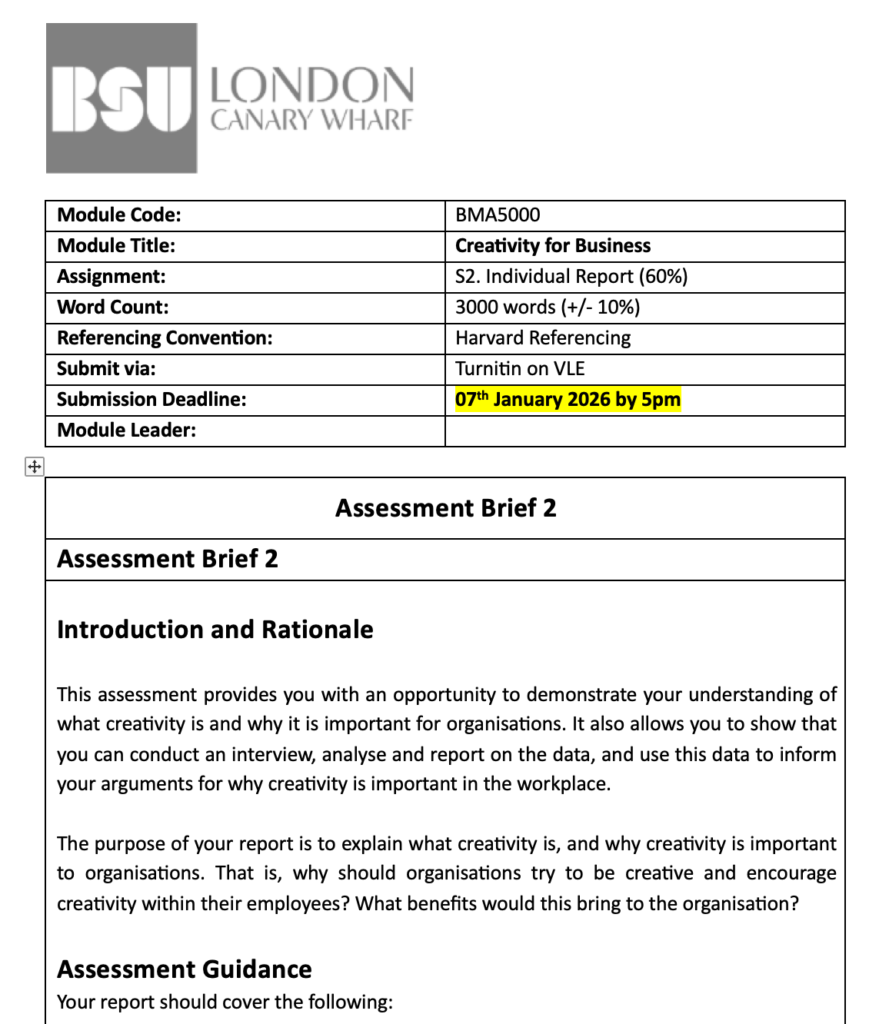
This assignment requires students to prepare a report explaining the importance of creativity within organisations. The report includes:
• Understanding and defining creativity
• Literature review with critical analysis
• Interview with a working professional
• Research methods and thematic data analysis
• Real-world examples and organisational benefits
• Conclusion and academic references
• Appendices including interview transcript, consent form, ethics form, and interview plan
Students are expected to use academic sources, conduct qualitative research, and present findings in a professional report format following university guidelines.
Overview of the Assignment
The purpose of your report is to explain what creativity is, and why creativity is important to organisations. That is, why should organisations try to be creative and encourage creativity within their employees? What benefits would this bring to the organisation?
Share Your Requirements & Get Personalized Support
Prices from
£30
Estimated costs for: Undergraduate 2:2
• 1000 words • 7 day delivery
Delivered on-time or your money back
Get the Academic Advantage Today
Every order with us is designed to deliver quality, reliability, and complete peace of mind.
What You Can Expect:
- Guaranteed On-Time Delivery – or your money back
- Subject-Specialist Writers matched to your academic field
- Thorough Quality Checks by our expert review team
- Complete Confidentiality – your work is 100% secure and never reused
- 7-Day Free Revision Support to ensure satisfaction
- Work Delivered as per Your Required Standards
- Plagiarism-Free Content with a detailed originality report
- Comprehensive Quality Assessment for added assurance
Solutions / Answer
Abstract
The analysis of the study has presented a brief explanation about employee creativity that drives innovation and also provides support to long-term organisational competitiveness. It examines the meanings of creativity and also examines why it is important for organisations that operate in the competitive business landscape. The methodology section comprised interpretivism philosophy, an inductive approach and an exploratory design. Primary data was collected using a semi-structured interview with a team leader of Lidl. The data was analysed using thematic analysis, which has identified key themes that are related to creativity. Moreover, findings reveal that employee creativity contributes to product, service and process improvement. Challenges that hinder or restrict the growth of creativity include work pressure and rigid organisational structures.
Introduction
Employee creativity is termed as a key factor that helps organisations to develop new ideas, make improvements in the overall process and help the organisations in staying competitive in the fast-changing business environment (Chaubey and Sahoo, 2022). As the market turned out to be globalised and the needs of the customers are evolving, organisations see no benefit in relying on existing products or their traditional ways of working. Creative employees are dedicated and focused towards sharing new and creative ideas, helping in generating innovative solutions, fostering growth, adaptability and achieving long-term success (Aldabbas et al., 2023). This particular topic helps managers to understand how to use creativity among employees as a tool of strategic advantage for achieving sustainable organisational competitiveness.
In today’s globalised business environment, organisations have given priority to creativity as a key driver that encourages the growth of innovation and a competitive landscape. Rapid technological change, global competition and the evolving expectations of the customers. Changing choices and preferences of the customers have encouraged the organisation to make continuous improvement in the products, services and internal processes. This particular study further builds on existing literature by clarifying the concept of creativity and explaining its organisational significance. It further explains the implications of methods and their justification, followed by discussing data collection and data analysis methods to subsequently examine how creativity among the employees influences innovation and long-term organisational competitiveness.
Literature Review
Define creativity
Creativity is recognised as the growing ability that encourages employees and individuals to form new ideas and suggestions that are useful for achieving positive growth and outcomes. One of the most commonly accepted definition about creativity is that it describes about the process through which new ideas and novel insights are being generated by the individuals or from that of the groups (Zhou and Shalley, C.E. 2024). The above definition highlights two important elements: first, all the ideas proposed need to be original or different from existing ideas. Second, they need to have value, meaning they can solve the problems, make improvements in the performance and look to create a positive outcome for the organisation. Keeping the balance between novelty and usefulness turns out to be key to most modern explanations of creativity. Another researcher explains that creativity, in a similar way, but it emphasises different aspects. For example, Shalley and Zhou (2024) state creativity as the key feature related to the skills of the individual, motivation and promoting a supportive working environment. This definition is closely related to Gilson (2024); both stress that creativity is a process that does not take place in isolation. Instead of that, creativity mainly depends on personal abilities as well as organisational conditions.
Some of the researchers focus more towards creativity as a process rather than as an outcome. According to West and Sacramento (2023), creativity, in simple terms, is mentioned as the key process that is considered to be a cornerstone that encourages original ideas, even if those ideas are not immediately implemented. This definition differs from that of organisational definitions, which often require ideas to be more useful or applied in practice. In business settings, creativity is usually linked directly to innovation and performance, which signifies that ideas are expected to contribute high value (Paulus, 2024). Furthermore, organisational studies often look to adopt definitions that explain the usefulness rather than the idea generation.
Reasons why creativity is important for organisations
Creativity’s role in organisation is undeniably important as it helps the organisation to survive, grow and at the same time remain competitive in an uncertain business environment (Tamm et al., 2022). Employees are being encouraged to think out of the box to help them think differently, questioning existing practices and also develop better ways of working.
Creativity as a driver of innovation
The key role that creativity is supposed to play in an organisation is to foster innovation, as it helps in bringing down creative ideas that are later developed into new products, services and processes. Organisations are being provided with instructions to undertake creative practices in their operations; failing to do so might force the employees to repeat the same traditional approach, which might restrict growth (Walsh et al., 2022). Creative employees suggest new or improved features that help in improving the delivery of the services, and also find new ways to meet the growing needs of the customers. In the growing competitive market, customers expect constant improvement. Organisations that fail to innovate risk losing market share to competitors who are much more creative (Souto, 2022). Moreover, creativity also encourages organisations to respond to the changing customer preferences and look to develop solutions that offer real value. Although creativity is not enough, it becomes necessary for the organisations to provide systems, resources, and also offer leadership support that help them in turning ideas into real innovations. Failing to gain such support, creativity might not grow and face the issue of its potential impact on organisations.
Improving problem-solving and decision-making
The role of creativity is also considered to be essential in solving organisational problems. Many of the workplace challenges, such as low productivity, growing costs or poor customer satisfaction, might not be solved using standard solutions. Creative thinking further allows the employees to see the problems from different viewpoints and also suggest some alternative solutions (Kusakli and Sönmez, 2024). For example, undertaking the approach of creative problem solving helps in minimising the waste, makes improvements in the workflow and looks ahead in enhancing well-being among the employees. This is especially important in complex environments where the problems are unclear and are also constantly changing. Furthermore, creativity supports better decision-making by encouraging open discussion and developing new perspectives (Harvey et al., 2022). Moreover, organisations that rely too heavily on strict rules and control might also limit the possibility of thinking creatively, which might result in slow responses and ineffective decisions.
Supporting organisational adaptability and change
Creativity enables organisations to adapt to change. Business environments are mainly being influenced by technology, economic shifts and facing competition from the global business marketplace. Organisations that encourage creativity are better prepared to tackle situations of uncertainty as the employees are more willing to experiment and learn. Moreover, creative organisations are often much more flexible; they encourage learning from failure and allow employees to test out new ideas (Turner, 2024). Employees growing a creative mindset among themselves allows them to make continuous improvement and implement change that brings out positive results. In comparison to those organisations that fail to encourage creativity, they fail to achieve the desired goals and face slow progress or reduced performance, failing to implement change successfully. Although providing too much freedom without any particular direction might also create confusion, hence the organisations need a balance between creative freedom and clear goals to maintain creativity that supports strategic objectives (Mutebi et al., 2022).
Enhancing employee engagement and motivation
Creativity is closely interlinked with employee engagement. When employees are encouraged to share ideas and look to contribute creatively, they feel much more valued and also respected. This sense of involvement further helps in increasing motivation and job satisfaction. Highly engaged employees are committed towards their organisation, and they are also likely to go beyond basic job requirements (Ahuchogu et al., 2024). Creative work further makes jobs much more meaningful. Employees enjoy tasks that enable them to think, learn and also grow. The overall activity helps eliminate the issues of monotony and employee burnout. As stated by Nendi (2024), organisations failing to encourage creativity among employees might face the issue of higher employee turnover and lower employee morale. Employees might feel excluded and feel that their ideas are not being valued within the organisation, leading to disengagement. Although creativity needs to be supported fairly. Bias during encouraging creativity among the employees needs to be minimised, where all employees should be provided with the opportunity to share their own thoughts and ideas, excluding others might increase team disengagement and conflict (Tumi et al., 2022). Hence, inclusive leadership is important to maintain creative benefits throughout the organisation.
Research approach and methods
The selection of interpretivism philosophy is justified because it allows the research scholar to grow their understanding regarding human behaviour, meanings and experiences. Employee creativity is mainly subjective, and it depends upon how the individual thinks, feels, and also grows interaction within their work environment. Interpretivism allows the research scholar to examine the employees’ personal views towards creativity and innovation apart from measuring them only through numbers (Kumar et al., 2025). Moreover, interpretivism also allows for understanding how culture within the organisation, leadership and daily work practices help in growing creative skills within their behaviour. Choice of interpretivism further allows the scholar to gain a deep understanding of how creativity is experienced by employees and how it seeks to contribute towards encouraging innovation and achieving long-term organisational competitiveness.
Research Approach
Based on the nature of the research, the researcher has made the decision to make effective use of an inductive approach. The choice of an inductive approach is justified because it allows theories and patterns to generate real data rather than testing out existing theories. Employee creativity and innovation are mainly influenced by individual experiences, growing workplace culture and developing organisational practices, which might differ across different contexts. Considering an inductive approach enables the researcher to explore these experiences in detail and identify new insights that might not be fully explained by existing models (Saharan et al., 2024). Moreover, the inductive approach supports open-ended data collection that comprises interviews, to grow understanding about how creativity is being perceived by the employees and how creativity encourages innovation.
Research Design
Selecting an exploratory research design is considered to be justified within the study because employee creativity and its overall impact on innovation and long-term competitiveness might differ across organisations and work settings. Undertaking this design allows the researcher to explore experiences of the employees, grow positive perceptions and understand behaviours in depth without relying on fixed assumptions. This method is beneficial for gaining new insights into how creativity is being encouraged, applied and managed within the organisations (Dubey and Kothari, 2022). The selection of exploratory research is justified as it provides flexibility, making it suitable for understanding complex and human-focused topics. Using the exploratory design also allows for determining key themes and patterns that explain how employee creativity looks to provide support for innovation and grow sustainable organisational competitiveness.
Data Collection
Based on the nature of the research topic, the researcher has undertaken primary data for this study that was collected directly from participants through questioning, considering a semi-structured interview approach. The interview was carried out via online Zoom with a leader of Lidl, which further allows the researcher to ask additional questions and examine responses in great detail when needed (Dzwigol, 2022). Undertaking this flexible approach encouraged the participants to openly share real experiences and views on creativity within the organisation. Carrying out the interview via online turned out to be practical and time-efficient, as it avoided the need for any physical meetings.
Data Analysis
Thematic analysis is justified in the present study because it helps in identifying patterns and also meanings within qualitative data that has been gathered from interviews. Since employee creativity and innovation are based on personal experiences and perceptions, thematic analysis allows the researcher to carefully investigate participants’ views and group them into clear themes (Islam et al., 2022). Undertaking this method is considered to be flexible and also suitable for interpretivist research, as it provides support for an in-depth understanding rather than performing numerical measurement. Thematic analysis also makes it easier to organise complex responses and link them to the objectives of the research.
Sampling
The selection of purposive sampling is justified in the present study because it helps in selecting participants who hold relevant knowledge and experience of creativity within the organisation (Singh, 2022). This technique has allowed the researcher to intentionally choose the individuals, such as team leaders, who look to provide meaningful and key details related to the research topic.
Ethical Consideration
Ethics maintained in the research study was keeping the personal information of the participant safe and secure. Participants were fully informed about the research purpose and also gave voluntary consent before taking part (Zou and Xu, 2023). Proper confidentiality and anonymity were ensured, and participants had the right to withdraw at any stage.
Data analysis
| Quotes from the transcript | Findings | Themes |
| Creative employees help in suggesting new ideas that help out in improving the products, services and internal processes. | Findings show that creative employees hold a key place in improving organisational performance. Employees sharing new ideas help in enhancing products, improving the quality of services and making internal processes much more efficient. | Employee creativity as a driver of product, service and process improvement. |
| Teamwork has a positive effect on creativity within the organisation as it inspires staff to share their ideas and also learn from each other. Working together allows different viewpoints to come together, which often leads to better solutions. | Teamwork provides strong support to creativity within the organisation. Collaborative working encourages employees to share ideas and also learn from one another. Encouraging different perspectives allows employees to solve problems and fosters performance and innovation in the firm. | Teamwork and collaboration enhance creativity through shared ideas and perspectives. |
| Several challenges limit creativity within the organisation, which mainly include strict deadlines. The strict deadlines prevent the employees from performing tasks on time. Hence, it fails to encourage employees to think of new ideas, and due to strict rules, it reduces the flexibility. | Findings state that organisational pressure limits employee creativity. The employees face challenges that restrict the growth of creativity among them, such as heavy workloads, strict deadlines, and limited opportunities to foster creative thinking. Moreover, strict rules and strict norms decrease the flexibility among the employees, decreasing their creative thinking. | Work pressure and rigid structures are barriers to employee creativity. |
Theme 1: Employee creativity as a driver of product, service and process improvement.
Theme 2: Teamwork and collaboration, enhancing creativity through shared ideas and perspectives.
Theme 3: Work pressure and rigid structures as barriers to employee creativity.
Conclusion
References
Appendices
Key Takeaways
- The assignment requires a 10-page report on creativity’s importance in organizations, including literature review and interviews.
- Students must discuss how creativity fosters innovation and enhances problem-solving within a competitive business environment.
- Research involves interviews, thematic analysis, and a focus on employee experiences to explore creativity’s role in organizations.
- Key themes identified include creativity as a driver for improvement, teamwork’s impact, and barriers like work pressure.
- Ethical considerations ensure participant confidentiality and voluntary consent during research.
Estimated reading time: 14 minutes
